

Designed for Faculty & Instructional Designers
Learning Design Suite
Content Generation
Experimental
Assignment Language Assistant
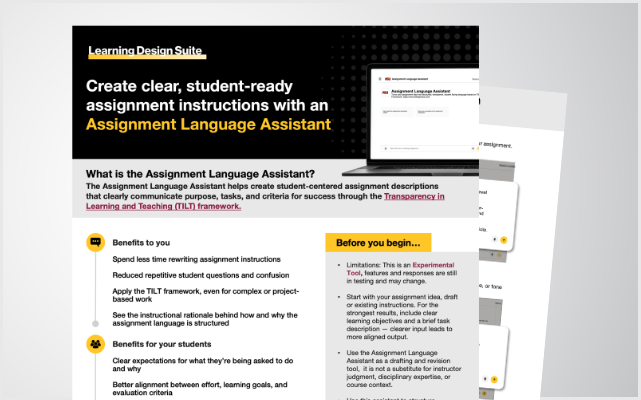
The Assignment Language Assistant (TILT Framework) drafts create clear, student-centered assignment descriptions using the Transparency in Learning and Teaching (TILT) framework. It turns assignment ideas or rough drafts into structured instructions organized around why they are doing the work, what steps to follow, and how they will be evaluated.

About this tool
Clarify assignment expectations with structure: The tool guides you in explicitly defining the assignment’s purpose, task, and criteria for success — making expectations visible without requiring major redesign or added grading work. It provides a strong first draft that’s easier to refine than starting from scratch.
Understand the rationale: Alongside ready-to-use instructions, the tool explains the reasoning behind the structure, helping you make informed adjustments aligned with your teaching goals.
- Revise while preserving your expertise: Refine phrasing and organization within the framework while maintaining disciplinary voice, instructional intent, and academic judgment.
Resources

Scholarly Foundation
The Assignment Language Assistant aligns with the Transparency in Learning and Teaching (TILT) framework, a research-based approach to assignment design that emphasizes clearly communicating purpose, task, and evaluation criteria. Studies on the TILT framework demonstrate that transparent assignment design can significantly improve student success, retention, and academic confidence. By aligning with these evidence-based principles, the tool supports clearer expectations, stronger student engagement, and more equitable learning experiences.
To learn more about the research that informs this approach, review the scholarly foundation resources.